Illustrated with numerous steel plates and wood cuts.
(p.
478 -
CHAPTER XXI.
IRREGULARITIES OF THE TEETH.
TEETH irregularly related to
the common arch are, under favorable conditions, capable of having the
malposition corrected without ill results.
Conditions to be appreciated
are: 1st, general and local health; 2d, age of patient; 3d, nature of alveolar
process.
A patient laboring under
dyscrasia, or one of extreme nervous temperament, will scarcely be found a
proper subject for the endurance of details necessary for the correction of
misplaced teeth: the first, by reason of a degenerating inflammatory action
almost certain to be provoked; the second, because of nervous excitability
aroused, which involves a risk to the health at large, of greater import than
any local good which may result.
A patient over twenty-five
years of age may, as a rule, be deemed to have attained to a solidity and
fixedness of stature which render the risk of change overbalancing the promise
of good. The period intervening between twelve and seventeen years of age is
found by experience to be the time of election for this class of operations.
An alveolar process of loose
structure is more capable of affording response to a mechanical impression than
is one of solid character. In the first, a tooth may be quickly changed in its
position; in the second, not only is more time required, but great increase in
the moving force.
Treatment which pertains to
regularity and harmony in the second denture commences with the first, the rule
being that a deciduous tooth is not to be extracted, save by compulsion, until a
successor is ready to take its place. (See Anomalies of Dentition.)
A tooth is changed in its
position by the application of force drawing in the required direction. The
physiological changes induced in the enveloping process are, first, absorption
of the parietes of that aspect of an alveolus pressed upon; second, the
exudation and organization of plasma in the part relieved. Change too rapidly
effected excites inflammation, or otherwise draws the tooth from its cavity;
haste in the correction
of an irregularity is never safe.
In
orthodontia,
as in every other department of surgery, familiarity simplifies practice. To
move teeth, but few means are really requisite. Complexities in appliances are
commonly found to signify lack of true skill.
A full consideration of the
associations of a case is to precede operation upon it. Such consideration
embraces, first, age. As a rule, it will not be found good practice to attempt
the moving of an undeveloped tooth, the parts being too susceptible and
irritable. (See Dentition.) Second, condition. Not only are the dyscrasic and
nervous conditions adverse to operation, but more immediate expressions are also
to be taken into account. Teeth, from the shape and direction of their crowns,
are sometimes to be recognized as possessed of peculiarities of fangs, which, in
a proposed change, must compel the piercing of the alveoli. Again, teeth of
bulky crown may have stumpy roots of such limited relation to their alveoli that
very slight traction will drag them from their sockets. A tooth out of the arch
may be a supernumerary; or it may in every respect simulate the true teeth and
yet not belong to the regular denture.
The inferior anterior teeth
of the second set are in nearly all in- stances found more or less irregular in
the manner of their eruption, if not unduly crowded from narrowness of the arch;
it will be the exception, however, where they will not prove self-correcting.
Also is it found the case that in nearly every instance where accommodating
space exists, irregularly developing teeth, wherever situated, will of
themselves seek proper relation. Early interference is there- fore, because of
such natural tendency to self-correction, to be deprecated, except where it is
evident that mechanical relations. render such self-correction impossible. A
single example may illustrate. Let a case be supposed where the superior central
incisors develop with their cutting faces so inclining inward, that in occlusion
of the jaws the inferior teeth close against the labial surfaces: here it must
be seen that time, instead of serving to correct the deformity, will only
increase it. In such an instance, a correction as immediate as possible is
desirable. Judgment must direct the means and the manner: the superior teeth
should certainly be placed outside of the inferior: if it is done without
provoking inflammatory resistance, however accomplished, the means employed have
necessarily been judicious. (See illustrative cases.)
Instances, again, are met
with where certain teeth have completely changed position: a lateral incisor
appearing in the situation of the central, the central occupying the place of
the lateral. Here there is no correction possible, except it be found in
extraction of the teeth and their rearrangement upon a plate, or through the
pivoting process.
Teeth irregular to the arch,
and held in the false position only by pressure from the articulating teeth,
find easy correction; forced into proper place, the same teeth which continued
the deformity will prove the instruments of permanency to the new relation.
The apparatuses used for
correcting
irregularities are to be as delicate as regard to a necessary strength
will allow they are to permit of ready change of form or relation to suit the
constantly varying requirements of cases; the construction and application
should. be as simple as practicable, that thus, as much as possible, the
assistance of the patient be engaged; they are to be easy of removal and
replacement, that thus a necessary cleanliness be secured.
In the relation of plates to
the necks of the teeth, care is to be exercised that unduly sharp edges shall
not cut the enamel; while in the employment of gum rings, now in most common
use, attention is demanded to the avoidance of injury to the gums so apt to
ensue from the sliding up of the ligature, a result easily avoided by placing
between the gum and ring a thread of waxed silk tightly tied around the tooth.
Teeth changed, through
mechanical means, in position, are to have support in the new location until the
required alteration is effected in their alveoli. This support is most commonly
seen to be given by nature: as for example, where a tooth being inside of the
arch and so retained by the overlying teeth, being forced out- side, is equally
compelled to retain the new place by the pressure of the very same teeth. In all
cases, however, where circumstances deny natural support, advantage is to be
taken of mechanical appliances; such appliances being found in ligatures, metal
bands, or plates.
With such appreciation of
the simplicity of the principles underlying the
practice of
orthodontia,
a few illustrative cases in practice may be presented as hints to the ingenuity
of the practitioner.
ILLUSTRATIVE CASES. --
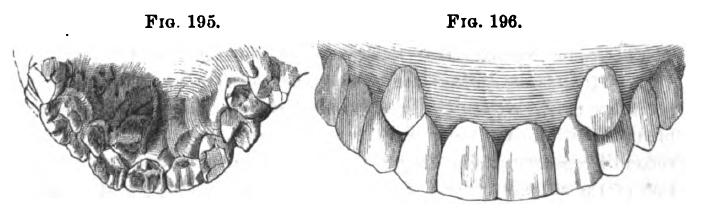
Fig. 195 exhibits a cast taken from the living mouth, in which, as is seen, the
bicuspidati and lateral incisors approximate. Age of patient, ten years.
Studying this case, it
becomes recognized that a required space is absent, namely, that for the
accommodation of the cuspis of either side. At eight years of age, the incisor
found its place; at nine years, the bicuspis. Most important was it that the
space occupied by the deciduous cuspis should be preserved by the retention of
that tooth until the eleventh year, the period of eruption for the permanent.
Not preserved, the room naturally became occupied by adjacent teeth; hence
irregularity was
inevitable: unless, indeed, it should have happened that the second cuspis
remained unerupted, a matter which must always necessarily occasion more concern
than even a deformity. Fig. 196 exhibits a front view of a similar mouth, the
cast being taken in the fifteenth year, four years after the eruption of the
cuspidati. This
irregularity is the one most frequently to be met with.
FIG. 195. FIG. 196.
TREATMENT. --
If an arch so presenting exhibits a proper articulation, that is, if the bite is
as described on page 109,-then a practice lies between the removal of the
projecting cuspidati, and that of the immediately adjoining bicuspidati.
As facial expression is
concerned, it is to be remembered that much of character resides in the eye
teeth. Many mouths from which these teeth have been removed possess a flat,
expressionless appearance, most undesirable. Again, it is found that these teeth
serve as keystones to the arch: hence it frequently follows that secondary
irregularity
associates with their removal.
Where a mouth with
overriding eye teeth possesses proper articulation, that is, where the superior
incisors fully override the inferior; where the bicuspidati resemble in their
labial outlines the cuspidati, and where the approximation of these teeth with
the lateral incisors is complete and regular; where the cuspidati are situated
well for- ward, and not over the bicuspidati, or even over the interspaces;
where the patient is advanced in years, the process having become fixed in its
relations: it is, in a case of this kind, the proper practice to extract the eye
teeth. On the contrary, where the patient is young, where the articulation is
harmonious, where the projecting teeth are situated over the interspace, or,
still better, posterior to it; where the bicuspidati do not simulate in
appearance the cuspidati: the practice proper to be pursued consists in removing
the under- lying premolars. Here, however, arises a question. The anterior or
six-year molars, of all teeth in the mouth, excepting perhaps the dentes
sapientiæ, are the most frequently found decayed. If these teeth are seen to be
carious beyond the ability of cure, and if the first or underlying bicuspidati
are sound and healthy, will not experience indorse the saving of these latter
teeth and the extraction of the diseased organs?
Experience exhibits that the
developing tendency of the teeth is always in a forward direction; the
extraction of a first molar does not favor to any extent the accommodation of
the cuspis: the second bicuspis will not fall back into the space made. On the
contrary, a second
irregularity is favored in the immediately manifested inclination of the
second molar to fall obliquely forward, thus breaking the harmony of the
grinding relations.
The preservation of the
first molar teeth is of great importance to the usefulness of a denture. It is a
great misfortune where they have been neglected.*
A third condition of this
special deformity is met with where it is evident that the slightest curtailment
of the arch would destroy the harmony in articulation,-that is, the overriding
is so slight that the extraction of two teeth might possibly result in the
anterior teeth closing directly upon each other, or perhaps, indeed, in the
inferior teeth closing outside. Two lines of practice here present. The
bicuspidati may be removed as before directed, and by the employment of an
occipitomental elastic sling, exhibited and described on a succeeding page, the
inferior arch may be retracted; or the superior arch may be enlarged to an
extent which shall afford the required space through the aid of instrumental
assistance; or, still again, equality may be maintained by the extraction of
corresponding bicuspidati from the lower jaw.
- - - - - - - - - - - -
* The inferiority of the first molars is
fully recognized. Mr. Tomes suggests the removal of these teeth under the
circumstances we consider, founding his practice on the following statistics:
"Under the age of fifteen the respective liability to loss from caries runs in
the following order: central incisors, 2 per cent.; lateral incisors, 3 1/2 per
cent.; canines, 2 1/2 per cent.; first bicuspids, 7 per cent.; second bicuspids,
8 1/2 per cent. ; first permanent molars, 68 1/4 per cent."
- - - - - - - - -
Of appliances used in the
correction of
irregularities, every variety is to be found. The operator will always,
however, find himself best served in employing the most simple means capable of
meeting indications.
FIG. 197.
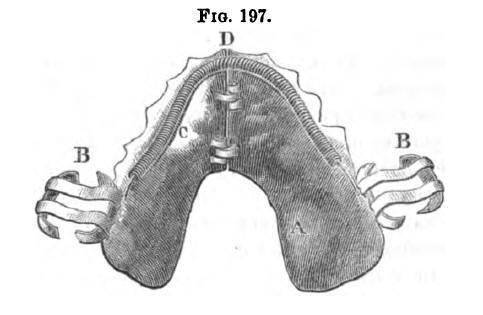
Fig. 197 represents an
appliance devised by
Dr. J. D. White, the office of its mechanism being the
enlargement of the whole superior arch and the consequent accommodation of any
outlying tooth or teeth. Taking an impression of an arch, a plate, in shape as
shown, A, is made; this plate, separated into two parts, has its association
preserved by a spiral spring, C, so arranged as to lie directly back of the
teeth, being thus as much out of the way as possible. B represents crib bands
for attachment to the first or second molar teeth, as may seem advisable. D, a
hinge, joins the parts in front; a device, however, which, for the purpose now
considered, is to be replaced with advantage by any arrangement admitting of
lateral separation on the line of division. It is to be recognized that in the
tendency of the spring to straighten itself the plate is separated, outward
pressure being thus exerted against each tooth.
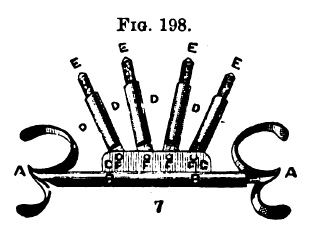 A second appliance, having
similar import, shown in Fig. 198, is the device of
Dr. A. Westcott.
This apparatus, as must be appreciated, possesses in its construction the
ability to move outwardly any tooth or teeth requiring change of position. The
instrument may thus be described: First, a double clasp A (A, A), these clasps
connected together by a straight bar made of tubular wire. This tube has a screw
cut in its inside the whole length, and is soldered to one pair of the double
clasps; the other pair of clasps are soldered to a wire which screws into the
tube, the object being to lengthen or shorten the bar at pleasure. Next a flat
piece (C, C) of sufficient width for hinge-joints is soldered to the bar. To
these are connected by hinge-joints (F, F, F, F) a series of tubes. (D, D, D,
D), each having a screw cut on the inside, these receiving and accommodating an
equal number of spurs (C, C, C, C). These spurs, as is recognized, screw back
and forth as may be desired, and are therefore capable of pushing (in time) any
tooth from its socket.
Such an apparatus prepared,
the clasps are slipped about the teeth for which they have been adapted, and,
slight depressions being reamed upon the posterior faces of such teeth as it is
designed to move, the spurs are screwed forward, the point of each thrusting
upon the depression prepared for it.
Examining the construction
of this piece of mechanism, its peculiar adaptability to the end designed must
certainly strike any one; a single weak point being the reamings used as
supports to the spurs, -an objection which may, however, in many instances, be
obviated by receiving the spur between a double ligature of gilling or book-
binder's twine.
The moving of the teeth
accomplished, the apparatus may at once be removed, the parts being maintained
in their new position by fitting a plate covering the whole roof of the mouth,
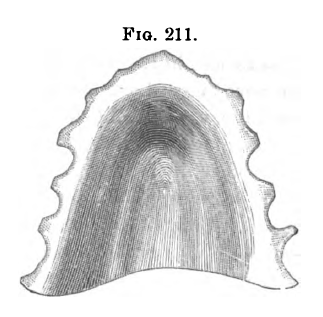
acting like a wedge in its relation to the common arch. Fig. 211 exhibits such a
retaining plate.
Still another means of
enlarging an arch to afford room for outlying cuspidati consists in adapting to
the lower denture an accurately-fitting envelope of metal, from the articulating
face of which pass upward and inward springy flat spurs, against which, in the
act of occlusion, the superior teeth close, thus being directed outward, and to
such extent spreading the parts. A spur, of course, is not to strike either of
the eye teeth.
Passing here to another
study, a case may be presented where, with room in the arch, the lateral
incisors maintain a posterior position.
Fig. 199 exhibits such a
condition. This is an
irregularity capable of quick correction, as exemplified in the use of
the bar (Fig. 200). This bar, being adapted to the labial face of the teeth, is
held in position by silk ligatures bound tightly to the misplaced teeth. A great
improvement on the silk, however, as has been shown by
Dr. J. H. McQuillen,
consists in the substitution of india-rubber rings, applied, as will be
understood by referring to the diagram, by being slipped into the holes through
file cuts made from the face of the bar.
FIG. 199.
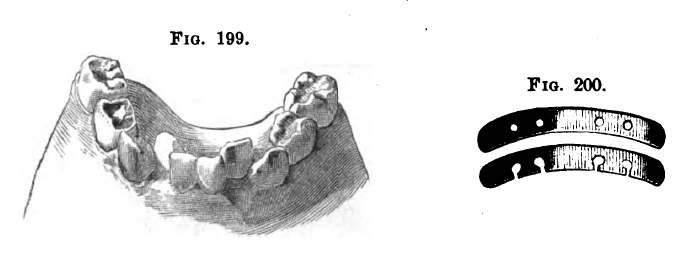
FIG. 201.
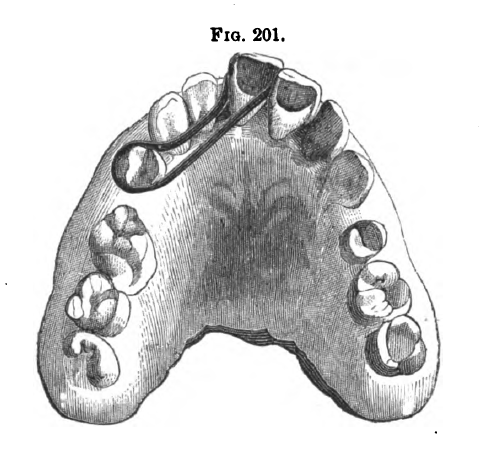
Another study is presented
in Fig. 201. Here, it is seen, a central incisor is out of the arch. To correct
this deformity a very common and very satisfactory practice is that exhibited.
This consists in an india-rubber ring thrown about the projecting tooth, being
stretched back until it reaches a bicuspis, around which it is placed. In thus
employing the elastic ring, it will not unfrequently be found that undue strain
is exerted upon the base-tooth, making it quickly very sore. In these cases the
ring is to be changed to other teeth, or assistance may be rendered by relieving
the first tooth of an excess in strain by dividing the work by means of a
ligature carried to some back tooth.
Fig. 202, a case from the
practice of
Dr. J. Foster Flagg, exhibits another deformity. Here, as is seen,
irregularity
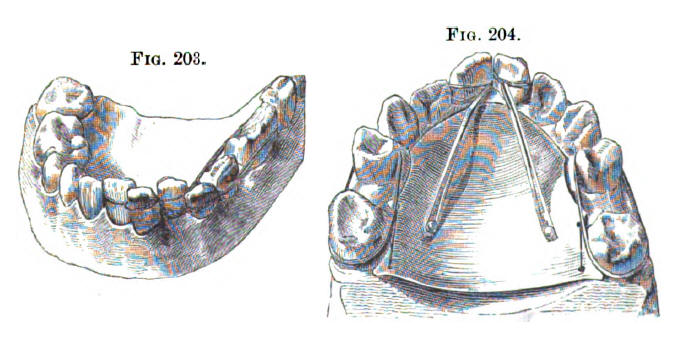
exists in both arches. "The treatment consisted in removing all the second
bicuspids, above and below, and throwing india-rubber tubing ligatures around
the six-year molar left inferiors, and the left inferior first bicuspid and
cuspid, drawing the two latter backward into the arch, at the same time passing
a silk ligature around the lower incisors (Fig. 203) in such manner as to force
into position an overlapping central. In the upper jaw a plate (not a necessity)
was adapted to the palate, secured by silk ligatures to the first permanent
molars. Pins were placed in the plate in such manner as to allow of the
attachment of two elastic bands, which were secured by silk threads to the
central incisors (Fig. 204), drawing upon the mesial face.
FIG. 202.
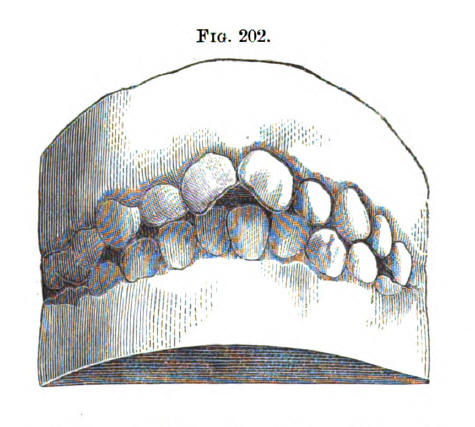
FIG. 203. FIG. 204.
Other bands were so arranged as to draw upon each lateral angle of the centrals,
passing between the centrals and laterals from their palatine faces, and running
along the labial and buccal faces unto the first molar of either side. Tubing
was thrown around the remaining superior bicuspid of either side and the molar,
for the purpose of approximating these teeth, thus affording space for the
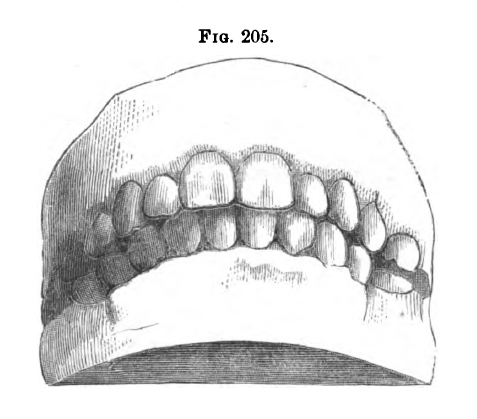
proper placing of the irregular centrals. By this arrangement, nine ligatures
were exercising traction at the same time, gradually and beautifully performing
their work of correction (Fig. 205). With the view of preventing
periosteal irritation from becoming periostitis, both local and constitutional
treatment was adopted, as the exigencies of the case seemed to require. Gentle
purgatives, as derivants, and tinct. aconiti rad., were used; chlo. potas. and
plumb. acet. as local antiphlogistics, and solution of aqua ammo. con. as an
antacid. The cure was effected in just two months, and, as the patient averred,
without any pain or inconvenience worth mentioning." -Description by operator.
FIG. 205.
 Another study, to which
attention may be directed as being a quite common condition, resides in that
articulation in which the anterior teeth of the superior jaw, in place of
overriding the inferior, close directly upon them. This manner of bite, when
found in elderly persons, is not to be remedied by any change in the position of
the teeth, but by the adoption of some mechanical device, which shall relieve
the organs of the abrading influence to which they are subjected, and which,
unrelieved, will wear them to the gums.
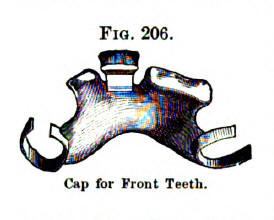
To treat such a
malarticulation, three modes have been employed: one consisting in a metal cap
inclosing the molar teeth, this keeping the anterior teeth apart and taking the
strain of mastication; a second, a cap to be worn over the front teeth while
eating (Fig. 206); and third, the cutting of cavities in the antagonizing faces
of the abrading teeth, and building thereon faces of gold.
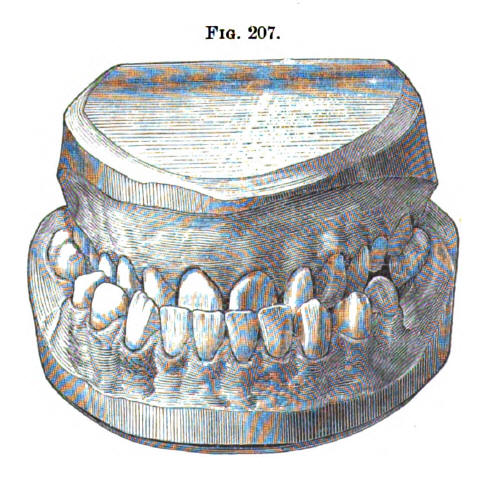
Fig. 207 exhibits a
malarticulation known as “underbung,"- the teeth of the lower arch closing
beyond the upper. To correct such a deformity, different operators employ
different means. a case presenting, a first consideration is as to the nature
and cause of the condition.
FIG. 207.
Protrusion of the inferior
teeth may exist from a variety of causes. The jaw itself may be elongated, the
angle being too obtuse for the age. The body of the lower jaw may be out of
proportion to the upper. The teeth themselves may unduly spread or evert. The
fault may be in the superior denture.
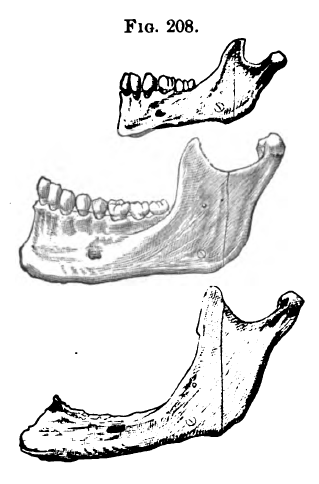 An anatomico-physiological
examination of the inferior maxilla exhibits a body and ramus whose angle of
relation varies with the age of the patient, or some other influencing
circumstance. At a very obtuse angle in young life, it passes to the right angle
in adult life, to fall again into the obtuseness on the approach of old age and
the loss of the teeth. The three specimens (Fig. 208) represent these
varying conditions, - the first, the infant bone, being very obtuse; the second,
the adult, being at a right- angled relation; the third, the bones of an
edentalous old person, having the ramus almost on a plane with the body.
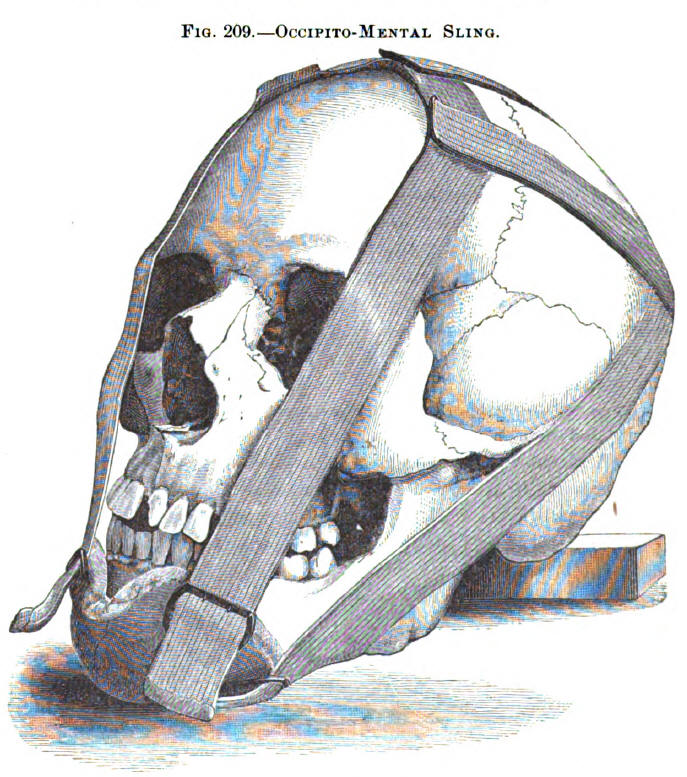
Where fault resides in the
superior arch, the jaw itself being small, or the teeth being possessed of
inlooking cutting faces, the appliance represented in Fig. 209 may be used, or
the envelope, with the flat spurs, may be employed, as directed for use upon the
lower denture (Catalan's inclined plane).
A mode of treating a case of
malarticulation such as is exhibited in Fig. 207-this cut being indeed a model
taken from this special mouth-has been practiced after the following manner with
a success as exhibited in Fig. 210, by
Dr. Norman Kingsley.
The external features of
this case, says
Dr. Kingsley,
showed, -
"1st.
That the lower jaw was not too large, being neither too wide nor too long. This
determination was easily arrived at by a comparison of the extreme lower part of
the face and head.
2d.
The same course of reasoning showed that, relatively, the upper alveolar border
and row of teeth were contracted so much as to produce limited external
deformity.
FIG. 209. - OCCIPITO-MENTAL SLING.
"To a casual observer, the
chin and lower lip were too full. To a more accurate observer, the upper lip,
cheeks, and nose were depressed. I suggested that immediate attention would
correct what otherwise would become an increasing deformity through life.
"The casts as represented in
Fig. 207 were taken, and the first fixture applied, January 19. Six days
afterward the incisor teeth of the upper jaw were overlapping the lower
incisors.
"On that same day, namely,
January 25, I gave a clinic, by previous engagement, under the auspices of the
District Dental Society of New York, on the subject of
Treatment of
Irregularities,' and I took an impression and made a cast of this case,
exhibiting it there as a part of my demonstration, to prove the rapidity with
which teeth could safely be moved into certain positions.
"Within twenty days from the
time the power was first applied to the teeth, the entire upper row was
articulating outside of the lower ones, substantially as shown in Fig. 210. A
retaining plate was adapted to the upper jaw, such as is shown in Fig. 211,
which was worn, with some unimportant modifications, for several months.
FIG. 210.
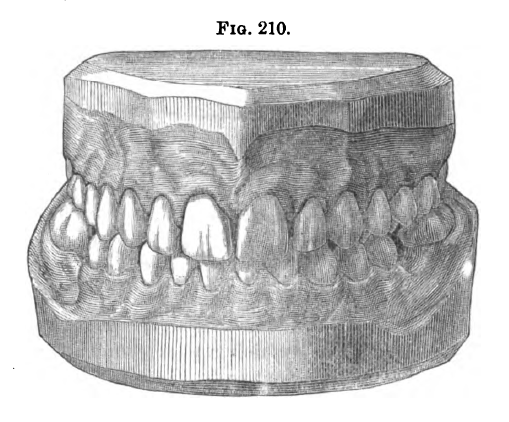
 "The result is a most marked
change in the profile, and in the relation of the external features. The
individual features being natu- rally well formed and symmetrical, the change in
their relations pro- duced a face of more than usual beauty.
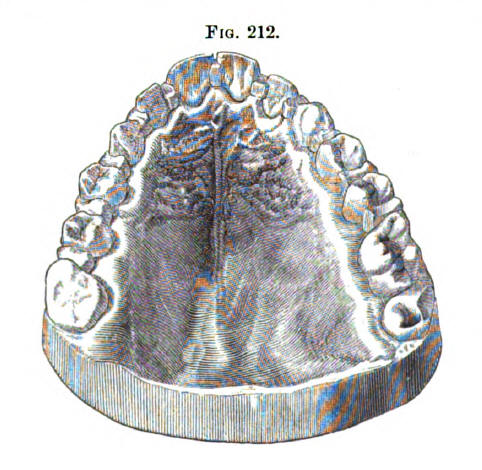
"The treatment consisted
solely of wedges inserted between the teeth, as shown in Fig. 212, in
conjunction with the retaining plate, Fig. 211. Wedges were inserted between all
the teeth, and worn from the first. These wedges were of elastic rubber, and
used of such thickness only as would exert a gentle pressure. The retaining
plate answered a twofold purpose: first, it kept the teeth from the possible
contingency of any one of them moving toward the centre of the mouth; and,
secondly, - what was of equal importance,-points of the retaining plate were
allowed to pass between all the teeth, which kept each wedge from slipping up
into and irritating the gum.
FIG. 212.
"The patient was watched
daily so long as the wedges were acting. When, by reason of their want of
thickness, they ceased to act, new ones, but slightly thicker, were substituted.
There was no more discomfort to the patient undergoing this process than is
commonly experienced in the wedging of one or two teeth in the mouth for the
purpose of getting space for filling. There was no soreness which called out
complaint from the patient. There was no favoring diet, nor was there any
provision made for masticating while the teeth were in transit.
"The teeth in their new
position and articulation, as seen in Fig. 210, have remained stationary now for
a period of three-quarters of a year. Not only is the external face improved,
but a longevity is guaranteed to these teeth by their isolation which could not
have been obtained by any other means.
"The foregoing statement is
not put forward as the report of a case to prove what is sometimes possible, or
what trials nature may undergo and still survive, but it is set forth as an
illustration of a
principle in the treatment of irregularities which has never before been
published. I have heretofore claimed something for æsthetic art in the practice
of dentistry; for the above I claim nothing but a recognition of pure mechanical
principles in dental practice. The wedge is one of the recognized mechanical
powers. Its application here is identical with its use by the architect for a
keystone in building his arch. Drive in the keystone, and the arch is
necessarily enlarged, and will continue to be enlarged so long as a wider
keystone is admissible and there is a support which will prevent the whole arch
from tumbling in ruin to the centre."
In attempting the correction
of a deformity as here suggested by
Dr. Kingsley,
special regard would necessarily have to be had to the more immediate results.
Without doubt the wedge is a most important means to the correction of an
irregular denture, but it is an agent capable of doing so much harm through the
irritability it provokes, that the cases must be few indeed in which it could
be. so largely made use of as in the instance just considered. This particular
case is employed, however, as an illustration, not that it may be commended to
the inexperienced, but rather to exhibit what judgment, aided by the most simple
of appliances, may accomplish.
A very simple and not
unfrequently effectual mode of correcting the deformity of protruding lower
teeth in young patients, applicable particularly where the organs close directly
against each other, consists in removing from the inferior arch the first
bicuspidatus of either side, which begets in the patient a habit of pushing the
chin backward; or the latter purpose will be answered by wearing the
occipito-mental sling during mealtime.
Among the various appliances
which ingenuity has suggested for the
treatment of dental
irregularities, is a plate devised by
Dr. Red-
man, of Cincinnati. This is a rubber cap accurately fitting the palatine arch
and carried across the anterior face of the teeth, having thus, as is seen, a
most secure relation. Where it is desired to move a particular tooth, the plate
is cut away in the direction which it is desired the tooth shall take, pressure
being brought to bear from the opposite point by wedges of wood forced through
holes in the plate.
 In
correcting
irregularities of the teeth, it is always necessary to bear in mind the
antagonism which may exist to the moving force as relation is had to the
articulation. A tooth bound in place by one overlying may only be moved through
relief from the existing pressure. To insure such relief it is found necessary,
in almost all cases, so to cap neighboring teeth as to compel a space between
the two arches, such space to be preserved until the tooth is changed to its new
position, when the removal of the cap and the restoration of the articular bite
will, in many instances, prove the best means that can be adopted for securing
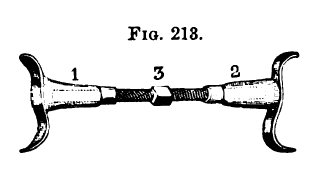
permanency to the change. Fig. 213 represents a principle found most useful in a
great variety of cases
of dental irregularities. An example of its application may be given as
follows:
CASE. -- Two central
incisors turned upon their axes and over- wrapping; arch narrow and crowded.—To
turn teeth so situated, a first necessity is room. To secure this room the arch
must be widened. Examination of the instrument exhibits double collars for
resting against teeth on opposite sides of the arch: these collars are attached
to screw-cut tubes 1, 2, which tubes are associated by a common screw, 3.
Desiring to widen the arch and thus afford facility for manipulating the crowded
incisors, the collars are placed against the inner faces of the teeth designed
to be moved, when, by means of a wrench, the screw is turned, the arms being
extended day by day as circumstances permit. The desired space thus secured, a
plate is fitted to insure retention of the teeth in the new position, when the
teeth may be turned into proper position, as practiced in the example from
Dr. Flagg.
Illustrating the use of this
means in another instance, reference may be made to lateral incisors, or other
teeth fallen within the arch and overlaid by their fellows. Here application of
the enlarging force is made in the same manner. When the proper room has been
secured, the misplaced tooth may with all facility be drawn into place by the
labial plate and elastic ring, as before described, a manipulation which would
be impossible without the previous expansion.
Repeating to the reader the
conviction that the
principles of orthodontia are of much more consequence than a knowledge
of special appliances, the subject may be left with assurance that the
illustrations given are all that can be needed to afford the requisite hints for
the government of such special or peculiar cases as may from time to time be met
with.